DPL-V-1500
1.Product description
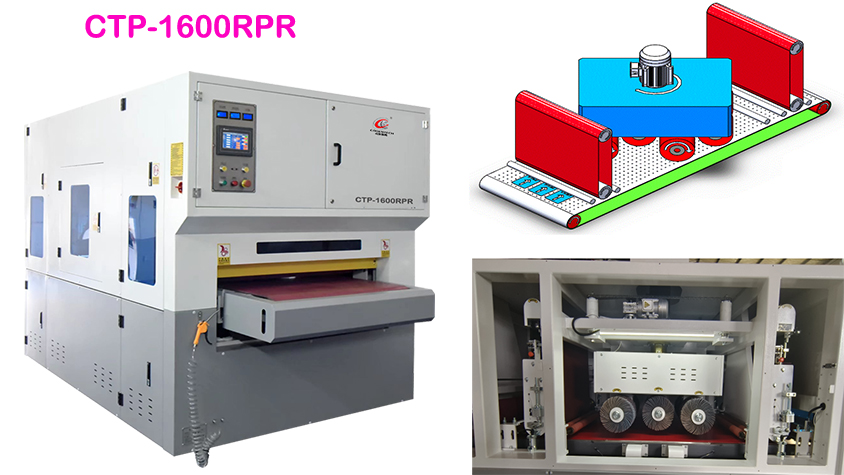
The RPR deburring and wire drawing machine is mainly used for deburring, chamfering, and wire drawing treatments on the surfaces of various metal workpieces to improve their surface quality and precision. This equipment integrates three functions—abrasive belt deburring, universal roller brush chamfering, and abrasive belt wire drawing—into one, enabling the completion of multiple surface treatment processes in one stop, thus enhancing production efficiency and the stability of product quality. It is applicable to stainless steel, aluminum alloy plates, iron plates, copper plates, etc. Different parameters can be adjusted and suitable abrasives can be selected according to different processing requirements
2. Features
(1). Deburring and wire drawing treatment on workpiece surface
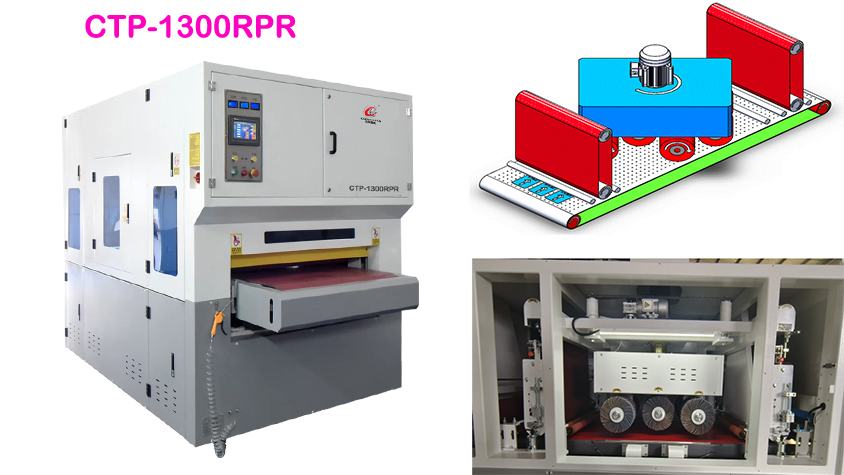
Equipped with two sets of wide abrasive belt structures. Driven by the grinding roller, the abrasive belts rotate at high speed to remove burrs such as slag particles, scale, and large flanges on the workpiece surface, while achieving high-quality wire drawing effects.
(2). Deburring treatment on workpiece edges and holes
Equipped with three rows (two sets per row) of universal roller brush structures. The roller brush abrasives rotate at high speed to flap the workpiece surface, making the surrounding edges and inner hole contour edges of the workpiece smooth and rounded to form a fillet effect. It can completely remove urrs generated during stamping, shearing, laser cutting, plasma cutting, etc., in one pass, ensuring all edges and holes of the workpiece achieve a small R-arc effect. The processing process is safe and reliable.
(3). Equipment conveyor belt
This equipment uses a high-damping rubber conveyor belt to transport workpieces, equipped with a vacuum adsorption platform and frequency conversion speed regulation. The material balances friction coefficient and hardness, ensuring sufficient friction while having a 50% longer service life than PVC.
(4). Equipment dust collection
The equipment is configured with one 5.5/7.5kW wet dust collector. Dust collection method: Most of the dust generated during the operation of the main machine is effectively sucked away through the dust collection port, eliminating the hidden danger of dust explosion and keeping the interior of the equipment clean.
(5). Adsorption fan
The total pressure difference reaches up to 8500Pa, with strong and stable adsorption force, ensuring safe and reliable operation.
(6). Sand belt motor
It realizes real-time matching of abrasive belt speed and feeding speed, avoiding the risk of burning thin workpieces and truly achieving cold grinding. The motor has high power, making product processing easier.
(7). Platform lifting motor
The platform lifting adopts a servo motor with closed-loop control, featuring fast response and high precision. In contrast, stepper motors use open-loop control with slow response and poor precision, resulting in significant differences when processing thin plates. The positioning accuracy reaches 0.01mm.
(8) Conveying platform
Following precision machining by a CNC gantry machining center and subsequent aging treatment, the flatness tolerance is controlled to within 0.02mm.
(9). Roller brush abrasives
Standard abrasives are adopted; the number of abrasive sheets is 12.5% more, the effective service length is 23% longer, and the comprehensive service life is increased by 38.4%. Cogentech uses universal abrasives, which are available in the local market.
(10). Conveyor belt cleaning
A cleaning brush is provided as standard. Most of the dust on the conveyor belt is sucked away by the dust collector, and a small amount remaining on the conveyor belt can be effectively removed by the cleaning roller, which can be collected for regular cleaning.
(11). Adsorption cavity cleaning
Cogentech independently developed an adsorption cavity cleaning function to realize automatic dust cleaning in the adsorption cavity, effectively preventing the risk of dust accumulation and explosion.
(12). Conductive slip ring
An industrial-grade conductive slip ring is provided as standard, with a service life of 80 million rotations, 5.33 times that of civilian-grade ones; the protection class is IP65.
(13). Alarm and display
This machine is equipped with complete alarm and display functions.
Alarms: Safety door open, abrasive belt not tensioned, abrasive belt deviation, low pressure in the adsorption cavity, roller brush abrasive replacement, motor overload, etc.
Displays: Abrasive belt current, adsorption cavity pressure, etc.
(14). Safety
The machine features a comprehensive anti-flying structure design. Anti-flying pressure rollers and anti-flying metal chains are installed at the inlet and outlet; all transparent windows are made of explosion-proof materials; built-in lighting uses explosion-proof lamps.
(15). Abrasive wear compensation
Cogentech independently developed automatic abrasive compensation technology, reducing manual intervention, ensuring uniform abrasive wear, and thus guaranteeing stable product quality.
(16).Control system
The equipment is equipped with a Delta high-definition touch screen, and the entire machine is centrally controlled by a PLC program, with comprehensive self-inspection functions, safety protection functions, and alarm functions.
3. Mechanism principles:
(1). Principle of abrasive belt mechanism
The deburring mechanism of this equipment is a wide abrasive belt structure. The wide abrasive belt mechanism is arranged longitudinally and adopts our company's patented lifting and abrasive belt deflection mechanisms, which can easily perform high-precision wire drawing on the workpiece surface and handle hard burrs such as blanking and curling edges.
(2). Principle of roller brush mechanism
The R-angle chamfering mechanism of this equipment is a roller brush mechanism. Three rows of roller brushes in the mechanism are arranged in a staggered and cross-opposed manner. Driven by a revolving shaft, 6 roller brush abrasives rotate at high speed and beat the workpiece, enabling uniform grinding and chamfering of the workpiece at any position on the conveyor belt.
(3). Principle of fixing and conveying mechanism
The equipment is driven by a high-damping conveyor belt, with a frequency-variable adjustable conveying speed. Workpieces are firmly fixed on the conveyor belt through a combination of pressure roller clamping and high-negative-pressure fan adsorption.
4. Specifications
MODEL | UNIT | CTP-800RPR | CTP-1000RPR | CTP-1300RPR | CTP-1600RPR |
Table width | mm | 800 | 1000 | 1300 | 1600 |
Machining thickness | mm | 1-100 | 1-100 | 1-90 | 1-80 |
Min.machining size | mm | ≥50x50x0.5 | ≥50x50x0.5 | ≥50x50x0.5 | ≥50x50x0.5 |
Feeding speed | m/min | 1-7 | 1-7 | 1-7 | 1-7 |
Sand-belt speed | m/min | 1-15 | 1-15 | 1-15 | 2.2-11 |
Roller-brush speed | m/min | 1-12 | 1-12 | 1-12 | 6-19 |
Rotating speed | m/min | 1-21 | 1-21 | 1-21 | 4-12 |
Motor power | kW | 39.15 | 48.35 | 78.15 | 89.95 |
Air pressure | Mpa | 0.6-0.8 | 0.6-0.8 | 0.6-0.8 | 0.6-0.8 |
Sand-belt size | mm | 1900x820 | 2200x1020 | 2200x1320 | 2200x1620 |
Roller-brush size | mm | 300x300x40 | 300x300x40 | 300x400x40 | 300x300x40 |
Overall dimensions | mm | 3200x1650x2250 | 3600x1850x2250 | 4300x2200x2250 | 4300x2200x2250 |
Machine weight | kg | 3000 | 4000 | 5500 | 6500 |
5. Applications